A regular feature covering the profiles of Great Filmmakers of World Cinema. Also, some leading Countries with their own distinctive and well-regarded movie styles.
French Cinema
A short survey (of an enormous cultural subject), by Richard Dunkley
Cinema was invented in France by the Lumiere Brothers in 1895. The
brothers screened moving pictures to sometimes terrified audiences who
often thought the images were real!. The Novelty rapidly progressed and very
quickly the potential to tell stories was seen, and Cinema was born.
In my English suburban youth, Friday night was family film night with a trip to
the cinema after a fish and chips dinner. We viewed films as family
entertainment and it seldom mattered what was showing, although it was
often Westerns. Cinema was a commercial enterprise there to entertain the
masses.
Things were different in France. Cinema was seen as the Seventh Art, the
total art form, that could (and does) combine all of the arts, visual,
storytelling, music, acting, etc. ‘Arthouse Cinema’ was created and has
never gone away for serious cinephiles.
With the greatest creative minds France becoming involved in film and some
of the finest directors in Cinema history, such as Renoir, Vigo, and Marcel
Carne emerging in the 1920’s, film became a almost sacred art form and an
intellectual pursuit. Film history and theory are taught in schools and the
subject is part of the high school Baccaulaurat exams; film is taken very
seriously.
France did not just participate in film history, it frequently re-invented it,
never more so than in the late 50’s and early 60’s with the Nouvelle Vague/
The New Wave, arguably the most influential movement in cinema history
and the subject of a separate article here in the future.
Of course not every French film is a serious masterpiece, they have a very
successful commercial cinema industry frequently second only to the US in
global sales. But Arthouse Cinema is protected and Cinema in France is the
oldest, most subsidised and culturally protected Film industry in Europe.
Screening Quotas ensure that a minimum of 40% of films shown are French
productions. Most major cities in France have subsidised ‘Arthouse’
Cinemas for showing historical and ‘serious’ films. The Cannes Film Festival
is still considered the most prestigious global measure of film quality.
French Cinema continues to innovate, inspire and influence like no other
national cinema industry.

Alain Delon
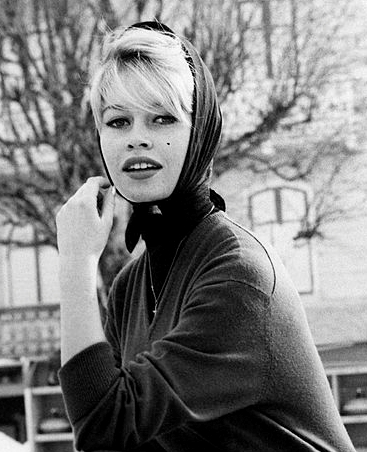
Bardot
___________
_____________________________________
_____________________________________
Italian Cinema after Neo-Realism
Like France, and its New Wave, Italian filmmaking went through a major change of priority after WW II. ( Mussolini had been executed and the German occupation came to an end in 1945). The main studios at Cinnecetta in Rome had also been badly damaged during the war. Filmmakers like Visconti, Rosellini, De Sica and Antonioni began working on the streets and villages, mostly with local people who were not experienced actors. Known as Neo-realism, the purpose of these changes was to concentrate on the post-war working class, poverty, despair and loss. The switch to this emphasis had first appeared in 1943 with “Ossessione” by Visconti, followed by Rossellini’s “Rome, Open City” in 1946. Vittorio Di Sica followed with “Miracle in Milan” in 1951 and “Umberto D “ in 1952. “Bicycle Thieves” by De Sica is also recognized as a classic of the genre, from 1948.
(Some of these films have already featured in Greattakes’ earlier programme of showings).
The emphasis changed in the later 1950’s, as new political initiatives took hold in Italy, and promoted a more positive view of the social and economic future for the nation. Federico Fellini then began to concentrate on individuals with a series of studies, many of which are to some extent autobiographical such as “La Strada”, “81/2”, “Amarcord”, “La Dolce Vita” and others.
By 1963 Visconti had moved to more lavish films with well-known actors such as “The Leopard”. Some comedies and satirical works also became popular. The club will show “Il Postino” (1994) and “Christ Stopped at Eboli” (1974) in November.
Profiles of Directors who ‘made’ Cinema
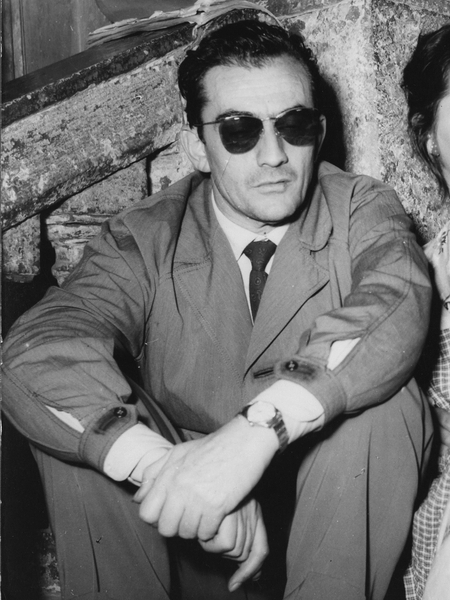
Luchino Visconti 1906-1976:
A brief biography by Richard Dunkley
The great Italian film director Luchino Visconti (Count of Lonate Pozzolo), was born into high aristocracy and had a life as grand and complex as many of his film characters, from his noble birth living in Palaces and Villas, to resistance war hero, to revered theatre, opera and film director. Visconti was a devout catholic and committed communist, who hated Mussolini’s Fascist regime and was imprisoned by the Nazis, narrowly escaping death; his life was like an epic movie in itself!
It is extraordinary that a nobleman of Visconti’s standing, (after starting as Jean Renoir’s assistant), should virtually invent the Italian Neo Realist film movement in 1943 with his first feature, ‘Obsessione’. This was an adaptation of James M Caine’s book ‘The Postman always rings Twice’, transposed to the poverty stricken Po Valley. The film was banned by the Fascist regime for its depiction of the Italian proletariat, ‘reeking of deprivation, lust and violence’, and was not seen in Italy until after the war.
Visconti in his early work, along with De Sica and Rossellini, used real locations and local people as actors, and shot in gritty black and white. Their style was hugely influential on the film Industry worldwide, and Neo Realism was a precursor of the French New Wave. Even now Realist directors like Scorsese, Coppola, Ken Loach and Chloe Zhao (Hamnet) acknowledge its influence on them.
Post war, Visconti’s career flourished dividing his time between Films, Theatre and Opera, winning awards and acclaim in all three mediums. His cinema evolved over fourteen films from his early neorealist work studying poverty and workers, to themes of aristocratic life and decadence and the decay of the bourgeoisie. Visually they ranged from the almost documentary early films to the lavish, opulent details, colour palettes and sumptuous cinematography of the later work, like The Innocent and The Leopard.
Visconti had a vast vision and is without doubt one of the great Cinema Geniuses.
British Cinema
HOW BRITISH WAS THE BRITISH FILM INDUSTRY?
British inventors played a leading role in cinema’s early years, from the very first film (Leeds 1888) to Frieze-Greene’s early films (Clovelly Cottage, 1895) and early colour experiments. The First World War destroyed all this, as so much else, paving the way for Hollywood to move in as the UK industry concentrated on war films (“The Battle of the Somme”1916). The 150 feature films of 1920 shrank to under 40 by 1925, as the UK industry howled for tariffs and quotas, while decrying state bureaucracy.
A quota Act (1925) insisted on more films shown being British, leading to “quota quickies” of poor quality (it had to be amended later), though UK filmmakers successfully made the switch to sound talkies (Hitchcock’s “Blackmail” of 1929). My parents in the Thirties were only allowed cinema visits to watch films on the British Empire, catered for by the Empire Film Unit (1926-33) and Colonial Film Unit (1936-55).
By now everywhere had a purpose-built cinema (78 in Leeds alone by 1938) and vast Art Deco super-cinemas sprouted in all towns. Already such films as Hitchcock’s “The Lady Vanishes” paved the way for the golden age of UK cinema, as audiences swelled to 1.5 billion in 1943 to watch, not only war films but such masterpieces as “Brief Encounter” (1945).
After the war, in spite of a film finance crisis and a ham-fisted tariff on US films (1947-8), the industry produced the great Ealing comedies like “Passport to Pimlico” (1949), more films of British heroes (“Scott of the Antarctic”,1948) and rather too many war films like “Reach for the Sky” (1955). Then a combination of television and a renewed Hollywood push began the downward slide.
The industry fought back with the “New Wave” of really British films, often set in the North, such as Ken Loach’s “Kes”, but when Thatcher and Hollywood pulled the financial plug, films made shrank to 24, audiences to 54 million (1986 – 123 million-odd now). Then, the old Hollywood rival came to the rescue; starting with Kubrick (“2001” A Space Odyssey). In the later 20th and 21st centuries giants of British film making include David Lean, Ridley Scott and Christopher Nolan, and many others.
BOB DEWICK

